
One need only look at the Missouri landscape to see the elm’s lasting mark.
For a time, the American elm was North America’s preeminent shade tree.
Its broad, fan-like crown and long branches were an established feature of the skyline in parks and on the streets of older neighborhoods.
Most Missouri towns have an “Elm” street – a nod to the once stately trees that used to dominate our cities.
Dutch elm disease killed many of the trees, and it began putting more pressure on the remaining Elms.
Yards that still have an elm tree should watch their tree carefully for signs of harmful beetles or disease.
Identifying the Elm
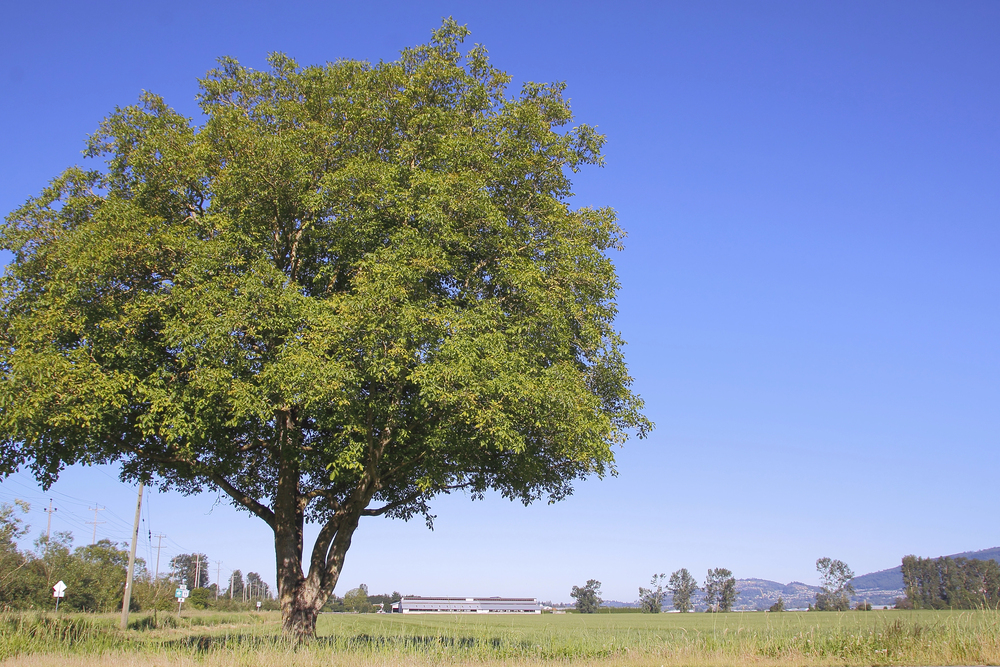
Native to much of eastern and central North America, Ulmus americana is well represented in Missouri, especially in bottomlands and along streams where the soil is moist. You will find them near understory trees as well.
Though some very large old elms are still around, they are not easy to spot. In full sun, the tree grows quickly to 70 feet and beyond, with a broad, fan-shaped crown.
There are a number of telltale signs of an American elm. The leaves, are simple and alternate in their arrangement, running 4 to 6 inches long by 2 or 3 inches wide. The leaves are dark green on the top and paler on the underside.
Their sawtooth margins set them apart from other species; the smaller teeth are tucked in among the larger ones. As for the young twigs, they tend to be reddish-brown before taking on a gray color as they mature.
The bark on the trunk is gray and deeply grooved with thin scales pressed close together. If you make a cut, you can see the white and brown layers alternating.
Between February and mid-April, weather permitting, the tree will produce small red or green flowers in drooping clusters.
With no petals and stalks all coming from the same point, the effect is quite delicate. In spring, the fruit shows up as a seed with a thin wing, about ½ inch long, often with silvery hairs at the edge.
In the fall, their leaves a bright golden yellow hue before dropping.
Elm Tree Facts
- Family: Elm
- Family: Ulmaceae
- Mature Height: 60-80 feet.
- Fall Color: Yellow
- Leaves: Double-serrated, 7 to 20cm long.
- Foliage: Deciduous
- Light exposure: Full sun (6 hrs direct light daily)
- Hardiness Zones: Zone 3, Zone 4, Zone 5 (Northern Illinois), Zone 6 (City of Chicago), Zone 7, Zone 8, Zone 9
- Soil preference: Moist, well-drained soil
- Drought tolerance: Tolerant
Lifespan and Value in the Landscape
It was their rapid growth as young trees that made elms so popular for shade. A well-placed elm can do much for curb appeal and property value, providing plenty of cover without shutting off the yard.
There are trade-offs to consider. The root system is extensive and should not be planted carelessly near drives or foundations.
Spring pollen is an issue for those with allergies, and a stressed or badly pruned tree will shed its wayward twigs and small branches.
Dutch elm disease is the greatest drawback. Prior to the Dutch Elm Disease, these trees would commonly live 200 years. These days, most Elms do not last longer than 30 years on average.
The Ceratocystis ulmi fungus is the culprit behind Dutch elm disease. Brought to the world’s attention in the Netherlands in 1921, it has led to the demise of hundreds of millions of American elms since then.
Elm bark beetles carry the disease. They feed on open wounds and dead wood. Then, they also feed on the young twigs of mature trees, introducing the disease into the water system of mature Elm trees.
Because of this, one must be mindful of when to prune. In the warmer months, an open wound is an invitation for beetles, and a poorly placed cut can let the disease in; it is better to put the shears away in the shed during spring and summer. For elms, the period from October to March offers the safest window for any work.
Then there is the matter of root grafting. Should the roots of two elms join, the fungus can make its way from one to the other and put the whole tree at risk. If you are putting in new plantings, keep them 50 feet or more from an existing elm where you can.
Spotting Trouble
An elm in poor health will usually make itself known with flagging: a single branch or part of the crown will have leaves that are wilting and turning brown or yellow. They may curl up and drop before their time.
In Missouri, one can expect these symptoms to be more pronounced from late spring to the end of July under the strain of heat and drought. Left unchecked, the problem will spread to larger limbs and the rest of the tree.
There are other indicators as well, such as a thinning canopy, peeling bark, insect activity, or even mushrooms at the base of the trunk. A cut into a diseased limb might show brown streaks in the sapwood. Since many problems present in a similar fashion, an annual check is prudent. Early detection of Dutch elm disease is what separates the loss of a branch from the loss of the tree.
Maintenance and Other Issues
Dutch elm disease is not the only thing an elm has to deal with; there is also elm yellows, canker, anthracnose, and leaf spot, not to mention storm damage and insect pressure. But a tree in good soil with proper mulch and sun will fare better against the elements than one left to fend for itself.
New transplants need to be watered until they are set in. Where the soil needs it, an organic macro- or micronutrient fertilizer can be of some help.
Pruning is a fact of life for long-term care. Young stock should be trained to have a strong central leader, while any dead or poorly attached branches are best removed. It adds to the vigor and life of the tree.
In the case of an early Dutch elm disease diagnosis, removing the affected parts can halt its progress. For a fine American elm tree, a preventative fungicide injection may be in order.
When an elm is past saving, it is important to have it removed and disposed of properly. Dead wood is a breeding ground for beetles and a hazard to the rest of the yard.
At Trufast Tree Service, we consider the property as much as the individual tree. Our certified arborists are on hand for a plant health care consultation to put forward the most sensible plan, whether that means an inspection, a treatment, or removal.